Between World and Stillness: What Ancient Teachings Still Tell Us Today
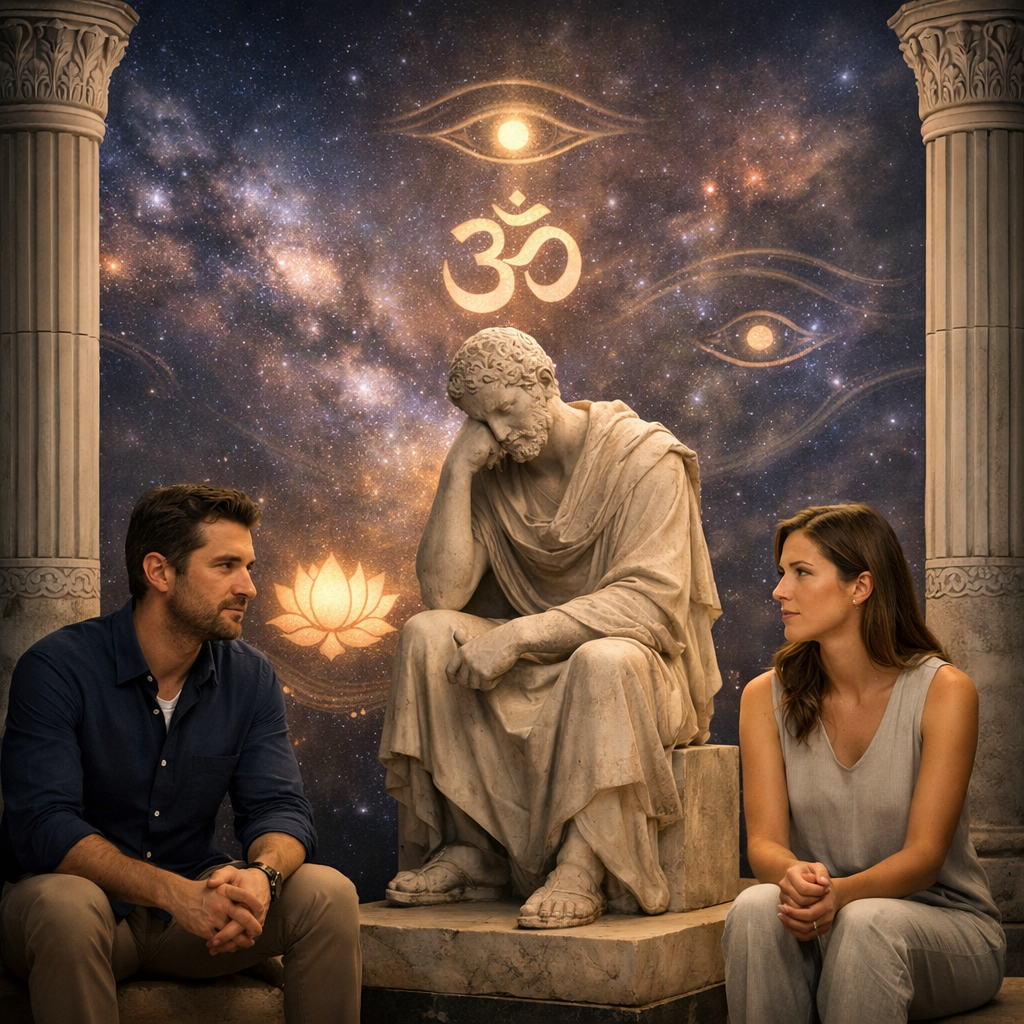
Although they emerged from different cultures and eras, certain philosophies share a similar inner structure without ever having met. Stoicism from the ancient Mediterranean world and the Vedic tradition from India belong to this category. Two traditions, two languages, two cultures — yet one common core: inner freedom does not arise from controlling the world, but from mastering the mind.
The Inner Movement Across Traditions
These ideas ultimately point toward the inner path and the freedom of the mind, even though they originate from different worlds. And despite their distance, they converge on the same insight: the decisive movement always begins within.
Ancient wisdom continues to speak to us in ways that are both enlightening and astonishing. At the same time, it is remarkable how often we overlook it. This may happen because knowledge alone changes nothing unless it becomes lived experience — a transformation that begins quietly and gradually reshapes how we see ourselves and the world.
Control and Non‑Control
Stoicism begins with a simple question: what lies within my power, and what does not? Although this question appears modest, it resolves more inner conflict than complex analysis because it brings attention back to the present. The past is memory, the future is projection; neither exists as lived reality. Therefore, the present remains the only place where life unfolds and where influence is real.
The present demands clarity and the right attitude. Furthermore, it requires the willingness to see situations constructively and to avoid people who drain energy or behave toxically. Releasing attachments without falling into indifference also becomes essential — not as withdrawal, but as a clear recognition of one’s limits.
Letting go is not laziness; instead, it reflects a sober understanding of what belongs to your sphere of control. Ultimately, we do not lose ourselves to the world, but rather to our expectations of it. And that is where suffering quietly begins.
The Vedic tradition conveys the same insight in a different form: act, but detach from the result — Nishkama Karma.[2] It means fulfilling the duties of the day, not those of yesterday or tomorrow. As Goethe wrote: “The duty of the day is the demand of the day.” Its depth often becomes clear only later in life, when we recognise how much energy we lose in fighting what cannot be changed.
The Mind as the Source of Suffering — an Inner Path
For the Stoics, suffering arises from false judgments and distorted perception. For Vedanta, suffering arises from false identification — clinging to things we are not and that should not define us. Both systems converge on the same truth: the event itself does not harm us; the meaning we attach to it does.
This process never truly ends. Yet the encouraging part is that one may begin at any moment — not by escaping into illusions, but by becoming more conscious in action, perception, and acceptance of what lies beyond influence. And in essence, the outcome is secondary, because the decisive movement always lies in the moment of action itself.
At any given moment, you have done your best. The result cannot be changed once the action is complete. Many mistake this stance for indifference; however, it represents clear inner distance — a foundation of emotional stability. Celebrate good results. Reflect briefly when things unfold differently. Then move on.
At its core, the journey is always an inward movement — a path toward the freedom of the mind, which gradually loosens the grip of fear, expectation, and identification.
Equanimity as a Competence
Equanimity does not imply emotional numbness; instead, it reshapes the way we relate to our inner world. This shift allows you to feel everything clearly without being driven by every impulse. The experience resembles watching inner waves rise and fall without being carried off by any of them.
Even so, the concept appears in both traditions. Stoic apatheia teaches the discipline of examining judgments before granting them power. Meanwhile, Vedic samatvam encourages a stance of not identifying with every feeling, role, or expectation. Together, they describe an inner balance that does not depend on external fluctuations.
In fact, this state is not withdrawal, but instead a conscious form of presence — awake, clear, and steady, and therefore capable of carrying you through uncertainty. Once experienced, even briefly, it becomes clear that equanimity is not only an inner attitude but a principle of resonance. The way you respond inwardly often shapes how the world responds to you.
An old proverb captures this well: as you call into the forest, so it echoes back. This applies not only to forests, but to the universe, to relationships, and to every form of exchange between people.
Virtue as a Way of Living
These traditions continue to resonate because their principles do not preach moral superiority, but offer inner protection — a framework that prevents life from becoming heavier than necessary. The body has its own forms of protection: armour, a raincoat, a roof. The soul, however, often stands exposed — vulnerable to words, expectations, judgments, and the small stings of daily life. And this is where these ancient teachings begin. They offer inner armour, a mental stability that deflects what once would have caused pain. Not because we become hard, but because we become clear — and thus resilient.
The soul may be like a trained body — resilient, flexible, and stable enough to withstand inner and outer storms. This may explain why ancient teachings continue to reach us. Their principles do not preach superiority; instead, they offer orientation and inner protection. Stoicism names its virtues wisdom, courage, justice, and moderation.[1] The Vedic tradition speaks of Dharma (right action), Sattva (inner clarity), Ahimsa (non‑violence), and Tapas (discipline and endurance). In both systems, virtue is not an ideal, but rather a tool — one that orders the mind and stabilises life.
The Difference in Aim
Despite their parallels, one decisive difference remains. Stoicism seeks inner peace within the world, whereas Vedic philosophy seeks liberation beyond it. One aims to optimise life; the other aims to go beyond ordinary experience. Yet both begin at the same point: the human being who must learn to lead himself before he can hope to understand the world. And through this inner leadership, both paths reveal their deeper unity.
It is plausible that both philosophies represent two expressions of the same universal movement — an inner growth shaped by discipline, clarity, self‑protection, letting go, and awareness. Viewed this way, these systems are not merely intellectual models but stages of development that bring us closer to something greater than ourselves. In the universe, everything merges; nothing exists in isolation.
Why These Systems Matter Today — Freedom of the Mind
In a time of constant stimuli, noise, and speed, these philosophies may seem opposed. Yet they may be tools to navigate precisely this world — to see through its superficiality and to grow instead of being led by it.
Ultimately, they share a common goal: shaping a better human being — not morally, but existentially, and therefore more capable of navigating a world defined by noise and speed. A human who thinks, feels, and recognises that the contradictions of the universe do not work against him, but are part of his nature. A human who understands that he is not separate from what surrounds him, but an expression of the same principle.
A Human Being in the Tension of the World
Moving with the current allows you to drift naturally with the water. Resisting it creates struggle. That is what Stoicism and Vedanta teach. Not passive surrender, but understanding the current that carries you. Not blind following, but conscious resonance. Not fighting where no fight is needed, but using energy where it truly transforms.
In many of these teachings, the same thread appears: the path inward and the freedom of the mind as the foundation of inner stability.
Beyond Action and Control
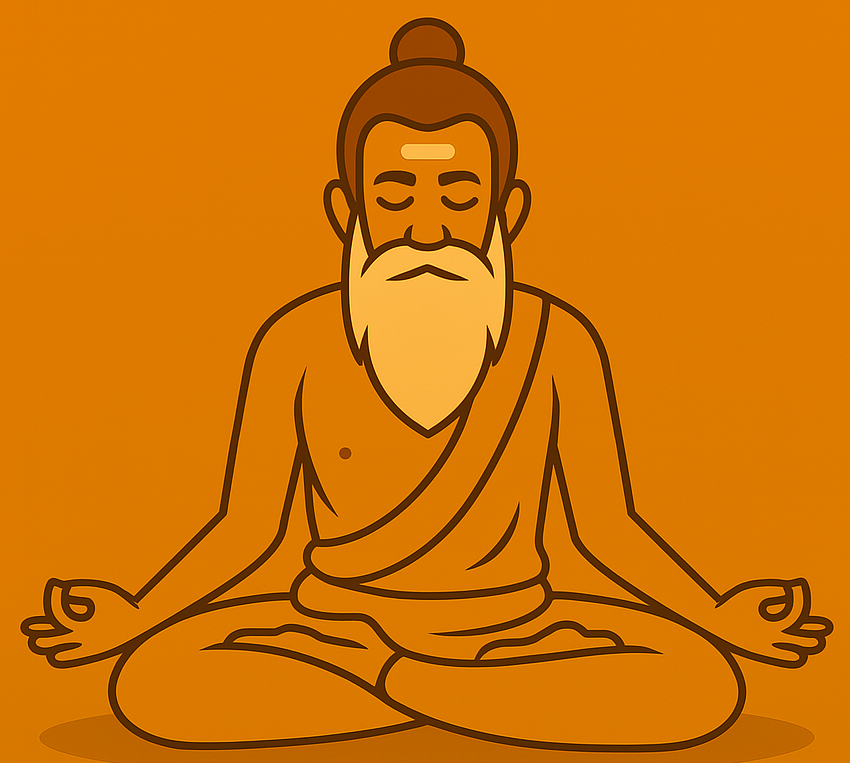
At the end of all these paths and teachings, a question older than philosophy itself emerges: what if the highest state lies not in action, optimisation, or striving, but in complete stillness? Sri Ramana Maharshi expressed it radically: if you wish to escape the entire cycle of cause and effect, do nothing. Do not become the doer. Become still. Total silence.[3]
This thought may appear to contradict Stoicism and Vedanta, yet it may represent the final step of the same ladder — the shortcut that only few can take because it demands absolute surrender. Not escape, not passivity, but instead a state in which the “I” that wants to control, plan, and judge simply dissolves. A state in which life itself acts and you remain as witness.
All these teachings share an ocean of knowledge — timeless, vast, and expanding like the universe itself. They give us tools to grow, protect, understand, and free ourselves. They remind us that we are part of a greater whole and that the answers we seek often already exist.
There is comfort in knowing that this knowledge endures. It does not vanish, even when forgotten. It grounds humanity or, when readiness appears, leads it into the vastness of the cosmos. Perhaps that is the true task of these traditions: not to change us, but to remind us who we have always been.
Perhaps the deepest freedom is found not in doing, thinking, or striving, but rather in the quiet stillness of simply being — complete in its own presence.
References
-
Marcus Aurelius – Meditations (Self‑Reflections).
Public domain edition:
https://www.gutenberg.org/ebooks/2680
↩︎ -
Bhagavad Gita – Chapter 2 (Sankhya Yoga / Nishkama Karma).
Public domain English translation:
https://www.gutenberg.org/ebooks/2388
↩︎ -
Ramana Maharshi – Talks with Sri Ramana Maharshi.
Archived primary source:
https://archive.org/details/talks-with-sri-ramana-maharshi
↩︎