
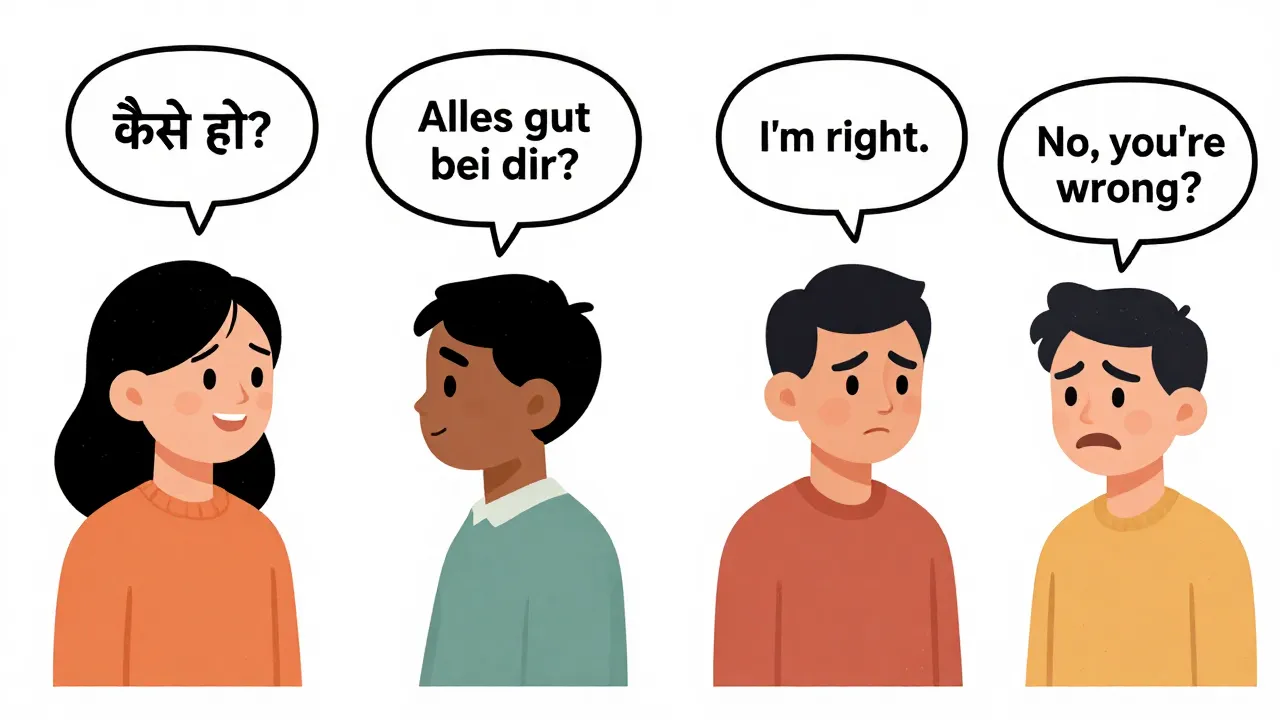
Introduction to Social Diversity
The Illusion of Language and Integration
The discussion about language and integration often presumes that fluency in a language signifies belonging. Moreover, it treats flawlessly spoken German as if it were proof of internal alignment. However, the German‑speaking regions themselves reveal how deceptive this notion is. Germany, Austria, Switzerland, Liechtenstein and South Tyrol all share the German language, yet no one would argue they are culturally identical. Additionally, they share some values, but these values are expressed in very different ways. Therefore, a common language links words, not perspectives.
Additional Context
Language and Integration: A Global Misconception
English often dominates conversations about language and integration. Indeed, today it functions as the global lingua franca — not because of its inherent appeal or logic, but due to its colonial legacy. It was used for governance, missionary work and control, and it was frequently enforced harshly in colonial schools, displacing native languages and reshaping generations. Moreover, English is far from a unifying language. It exists in many forms — British, American, Australian, Canadian, Indian, Jamaican, African and various Black American English dialects — each with its own history, sound and cultural identity.
Narrative Structure
Diverging Worldviews Despite a Shared Language
Meanwhile, countries like the United States, the United Kingdom, Canada, Australia and New Zealand share Anglo roots, yet their worldviews have diverged greatly. Consequently, a shared language aids communication but does not eliminate divisions in thought. Furthermore, this highlights the fragile link between language and integration.
Social Insight
Arabic, Identity, and the Limits of Linguistic Integration
Arabic presents a similar case — spoken across a vast area from North Africa to the Middle East, varying in sound, tone and usage. Moreover, it cannot seriously be claimed that a common language creates “Arab unity.” There may be religious ties, yet even those are fragile. Sunnis, Alawites and Ahmadiyya all speak Arabic, but their internal conflicts remain intense. Additionally, Arabic‑speaking Christians and other minorities further demonstrate that language alone does not form identity. Therefore, a shared language neither guarantees a shared worldview nor overrides religious or historical differences.
India: Shared History Beyond Linguistic Integration
India illustrates this point even more clearly. Moreover, many still view it as a linguistic unity, despite being a multiethnic nation with languages that differ in script and origin. Nevertheless, the country functions — not because of a common language, but due to shared history and identity. Hindi and Urdu are almost identical, yet the partition of India and Pakistan was not caused by language but by religion, worldview and conflicting values. Additionally, this historical division shows how deeply values can outweigh linguistic similarity. Hence, India demonstrates that language and integration often follow very different paths.
Africa: Multilingual Realities and the Myth of Integration
Africa provides another example. Moreover, borders were drawn arbitrarily, forcing culturally diverse groups to coexist. Still, many Africans speak multiple languages — English, French, local tongues and sometimes more. Multilingualism is common across the continent. Additionally, conflicts arise not from language barriers but from differing values. Linguistic differences have been overcome, yet disagreements persist. Therefore, this shows that language alone cannot create integration where deeper divisions remain.
South America: Shared Language, Divergent Societies
South America further demonstrates how little language or religion ensures unity. Moreover, almost the entire continent speaks Spanish, and Brazil’s Portuguese is close enough for mutual understanding. Yet the region remains highly diverse. Argentina, Chile, Peru, Colombia, Venezuela, Bolivia, Ecuador, Paraguay and Brazil share a colonial history and predominantly Catholic faith, but their political cultures, identities, conflicts and historical trajectories differ widely. Additionally, these differences show how shared language and religion facilitate communication but do not prevent divisions. Therefore, South America illustrates once again that linguistic similarity cannot override deeper societal dynamics.
South America further demonstrates how little language or religion ensures unity. Moreover, almost the entire continent speaks Spanish, and Brazil’s Portuguese is close enough for mutual understanding. Yet the region remains highly diverse. Argentina, Chile, Peru, Colombia, Venezuela, Bolivia, Ecuador, Paraguay and Brazil share a colonial history and predominantly Catholic faith, but their political cultures, identities, conflicts and historical trajectories differ widely. Additionally, these differences show how shared language and religion facilitate communication but do not prevent divisions. Therefore, South America illustrates once again that linguistic similarity cannot override deeper societal dynamics.
China: Cultural Unity Without Linguistic Integration
China stands as a strong counterexample to the idea that language unites a nation. Moreover, it lacks a common spoken language but shares a written script. Mandarin, Cantonese, Shanghainese, Hokkien, Hakka and other varieties often cannot understand each other verbally. Yet they share cultural frameworks, identity and historical awareness. Additionally, what unites China is not spoken language but script, history and governance. Therefore, China demonstrates how cultural cohesion can exist without linguistic integration.
Script-Based Unity and the Politics of Language in China
The Chinese writing system is a long‑standing cultural project that has fostered unity over millennia — a unity that never existed linguistically. A Cantonese speaker cannot understand a Mandarin speaker, but both can read the same text. Moreover, this is cultural rather than linguistic unity. Still, this unity is political rather than natural. The standardisation of Mandarin (Putonghua) is a state initiative, not an organic evolution. Additionally, language here serves as a tool for administration, modernisation and national cohesion rather than an expression of identity. Therefore, China illustrates how language policy can shape unity without resolving linguistic diversity.
Germany: Why Language Alone Cannot Drive Integration
In Germany, it is often argued that mastering German is essential for integration. However, experience shows differently: people who speak imperfect German can share the same beliefs, morals and sense of belonging. Moreover, others who speak flawless German may never truly feel part of the country. German public discourse often overestimates the link between language and integration. Additionally, everyday social interactions reveal that shared values matter far more than linguistic precision. Ultimately, language allows communication but does not create common ground. Therefore, it fosters understanding, not unity.
Language Does Not Connect Us – Values Do
Sharing a language only creates an illusion of closeness. Moreover, true integration depends on shared values. It is not language that unites or divides us, but the values we uphold, the histories we carry and how societies perceive themselves. Belonging begins where language ends. Words may sound alike yet hold different meanings. Additionally, what truly binds a society is not its language but the values it chooses to live by.
Perhaps the real question is not how we speak to each other – but how we understand what remains unspoken.