
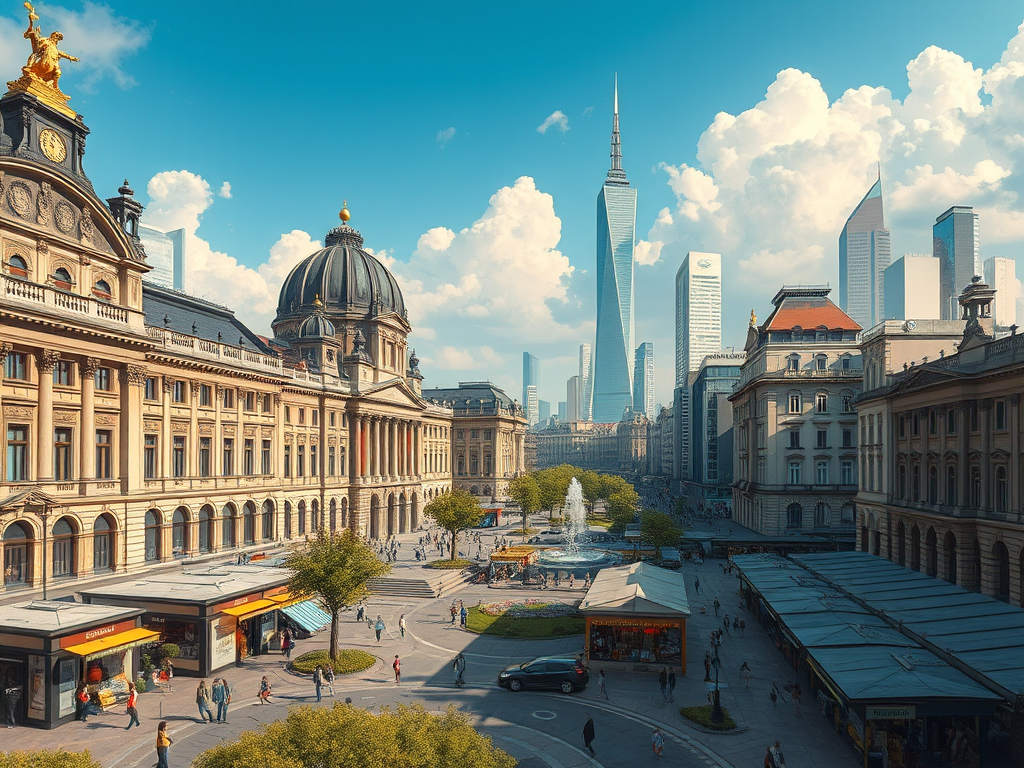
Why German Cities Need New Urban Guiding Principles
Mini-Dubai instead of Mini-Damascus
The cityscape debate is omnipresent. But while façades are being argued over, systemic thinking is often missing. This column was written long before the current discourse – but now it unfolds its relevance all the more. Because German cities do not need staged diversity, but functional elegance.
Wiesbaden: Historical Substance Meets Strategic Void
Imperial architecture and generous parks alone no longer meet international standards
With its imperial architecture, spacious parks, and proximity to Frankfurt, Wiesbaden offers everything a city with international ambition needs. But instead of targeted development, symbolic diversity dominates without functional depth. Places like Nerotal, Wilhelmstraße, or the Kurhaus are not merely nostalgic backdrops. They could be key axes of a new, progressive urbanity.
Culture unfolds its impact not through museal preservation, but through economic integration. Wiesbaden possesses history, atmosphere, and architectural substance – but without strategic capital binding, all of it remains invisible. What is needed is an urban logic that activates existing quality, not conserves it decoratively.
Further Reading:
Urban Development and Planning | German Institute of Urban Affairs
Luxury Is Not Elitism
Capital Binding Through Clear Architecture and Zoning Logic
Cities like Dubai and Abu Dhabi show how order, security, and quality of life emerge. These features do not come through wealth, but through structured spaces. German cities have the backdrop, but not the structure. What is needed are modular zones, not decorative diversity.
Further Reading:
Regional, rural and urban development | OECD
Education as a Location Anchor
Competence Instead of Origin – A Gulf States Model for Germany
The Gulf States invest in school quality, digital infrastructure, and international curricula. German cities could become educational hubs that retain talent. This is possible through dual educational axes (already present) and digital equipment, regardless of origin.
Security Is Quality of Life
Public Space as Activated Living Space
In Dubai, low crime rates are the result of zoning logic and quality of stay. German cities have parks and museums – but without a sense of security, they remain backdrops. A Mini-Dubai logic would enliven these spaces instead of merely preserving them.
Further Reading:
Sustainable urban development | BMZ
Digital Infrastructure as a Future Module
Smart City Instead of Wi-Fi Debate
While German cities debate Wi-Fi on buses, the Gulf States rely on blockchain administration and nationwide 5G. German cities need digital architecture that connects administration, citizens, and capital flows. A change.
Freedom and Market Economy as the Foundation of Urban Development with Social Inclusion
The longing for structure, security, and elegance
The city of the future needs not only order but also openness. Market economy and individual freedom are not opponents of functional urbanity, but its prerequisite.
Only in a free, competitive environment do innovation, diversity, and social mobility emerge. Cities like New York, London, or Paris demonstrate that economic dynamism and personal development can coexist. This balance occurs if the framework conditions are right. But if not everyone is included — especially the socially disadvantaged — the entire system is called into question. A city that offers structure but restricts freedom becomes sterile. A city that offers freedom but lacks structure descends into chaos.
The opportunity for German cities lies in the fact that they are not too large and still have the potential to make the leap into a new modernity. To achieve this, they must avoid swinging between ideology and improvisation. Instead, they should establish an urban order that enables freedom. This order should also foster social inclusion.
Berlin: The Paradox of the Capital
When Diversity Becomes an Excuse for Lack of Structure
Berlin is many things – creative, international, rich in history. But this very diversity is often misunderstood as a substitute for structure. The city lives off its image, not its infrastructure. While other capitals like Vienna, Copenhagen, or even Warsaw invest specifically in order, education, and digital administration, Berlin loses itself in symbolic politics, administrative chaos, and planning arbitrariness.
The capital exemplifies what happens when urban freedom is not connected to functional clarity. Public space deteriorates, social tensions grow, and investments fizzle out in a fog of responsibilities. Berlin has the potential to be a European metropolis – but it lacks the courage for order and an urban guiding principle that goes beyond improvisation.
India Shows: Elegance Without Structure Leads to Emigration
Mini-Mumbai Is Not a Solution
Indian cities like Mumbai and Bangalore are economically dynamic and growing at an incredible pace. They possess architectural elegance, but lack urban quality of life — and that leads to brain drain. People move away, and it shows: growth needs order; glamour alone is not enough.
Further Reading: Smart City Mission of India: Initiations and Schemes by Government of India
East Asia as a Success Model
Tokyo, Singapore, and Shanghai – Structure Meets Future
While many Western cities stagnate, East Asia’s metropolises show how urban complexity can be mastered:
Tokyo: Largest metropolitan region in the world – and still clean, safe, and efficient.
Singapore: Smart City with social permeability, educational strength, and digital administration.
Shanghai: Combination of global economic power and urban order – despite size and pace.
These cities show: size is no obstacle when structure, technology, and social balance come together. Just like Germany in the 70s/80s – when cities like Hamburg, Frankfurt, and Munich were internationally seen as models.
Further Reading: OECD Regions and Cities at a Glance 2024 | OECD
Functional Inspiration Instead of Cultural Overlap
Mini-Dubai does not mean cultural copying, but functional transformation
It is about an urban logic that focuses on order, education, security, and future viability. The population does not perceive this logic as foreign, but as progress.
The city of the future must offer accommodation and perspective to all people – regardless of origin and income. This is only possible if modernity and luxury are conceived not against, but with the citizens. Even those who have less must be capable of earning their livelihood there – visibly, integrated, respected. A functional reorientation of inner cities must not end in Mini-Damascus, but in Mini-Dubai. That would not only be structurally sensible, but also socially admirable – and would make our cities more livable. Europe should not only look westward, but also adopt modern elements from East Asian cities: structure, efficiency, social balance. An urban upgrade – not just for Wiesbaden, but for the entire country.