Tea in the Heart, Coffee in the System
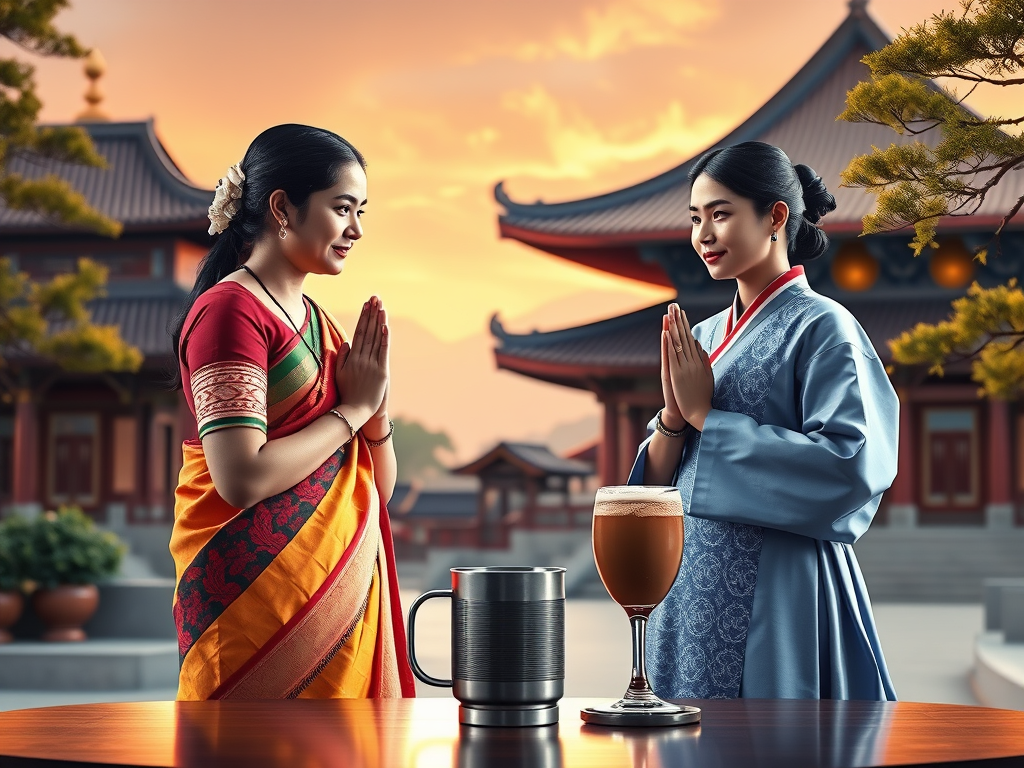
In Tamil Nadu, a state in southern India, and South Korea, tea is a beloved drink. However, coffee plays a crucial role in daily life. In Tamil Nadu, sweet filter coffee served in small steel tumblers marks a warm family ritual. In South Korea, the iced Americano dominates mornings. While tea remains the traditional drink, coffee signals the transition from private to public life. Despite differences in taste and temperature, both beverages serve a similar purpose: they provide structure and rhythm to daily routines. As Alice Waters, a renowned chef, puts it, „Food is an expression of identity. It reflects our traditions and brings people together.“
Fermented Nearness: Kimchi Meets Urugāy
Spice, patience, and microbes create a silent connection between kimchi in South Korea and urugāy in Tamil Nadu. Both are more than mere side dishes; they embody craft and depth of flavor. Both are fermented, both are spicy, and both accompany every meal. While kimchi is served cool, urugāy is preserved in oil. The similarity lies not in their recipes but in their function: fermentation as a daily ritual. Thus, food in both cultures is not merely an event but a system, and both are uncompromising in their heat.
Language as Structure, Not Only as Sign
Korean and Tamil belong to different language families, yet they function similarly. Both languages place the verb at the end of the sentence and use honorific forms. They rely on clear sound patterns, and although their scripts are different, they follow an inner logic aimed at clarity and rhythm. Here, language is not just a means of communication; it is also a form of order. Noam Chomsky, a noted linguist, states, „Language is not just a tool for communication, but also a window into the thoughts and culture of a people.“ This reflects how people think, feel, and move in the world, revealing the quiet connection between these cultures.
Christian Traces in Everyday Life
Christianity in South Korea is relatively young but deeply rooted, featuring large churches, early morning prayers, and clear rules. In Tamil Nadu, Christianity has a longer history and is often blended with local culture. Churches resemble temples, and statues of Mary are adorned with flower garlands. In both regions, Christianity serves as an extension of culture rather than a rupture, adapting without dissolving. Faith is quiet but structures life through rituals, songs, and community. Moreover, Hinduism and Buddhism exhibit similar systemic power. They are not dogmas but ways of life that teach moderation, compassion, and self-discipline, values also central to Christianity. In Tamil Nadu and South Korea, religions coexist, structuring daily life through attitude rather than power. The connection lies not in doctrine but in lived rhythm.
Film as Mirror of Body and Society
Kollywood and South Korean cinema tell stories differently but with similar depth. Tamil films often depict rituals, family conflicts, and educational struggles, frequently in loud, colorful, and musical styles. South Korean films, while quieter, convey intensity through themes of social coldness, school pressure, and silent rebellion. Both use the body as a means of expression, whether through fight scenes, dance, or glances. Film is not merely entertainment; it is a mirror of society. Martin Scorsese, a legendary filmmaker, observes, „Film is a powerful medium that tells stories capable of changing societal awareness.“ Although their aesthetics differ, both aim to tell stories that inspire action.
Cities as Nodes
Seoul and Chennai are central places that bring many elements together, though they differ greatly. Seoul is highly organized with clear rules and central control, while Chennai is diverse, home to many languages, religions, and political groups. Decisions often arise from exchanges between the city, region, and community. Busan and Coimbatore are key industrial cities, while Madurai and Gyeongju are known for their strong religious and historical significance. Despite their differences in appearance and structure, both cities fulfill similar roles in connecting people, economy, and culture. Their commonality lies not in their looks but in their significance to their surroundings.
No Korea but a Strong Tamil Nadu
Both Tamil Nadu and South Korea are economically successful, but they follow different paths. South Korea relies on discipline, technology, and global brands, while Tamil Nadu thrives through regional industry, quality education, international connections, and cultural diversity. Both regions are developing rapidly, yet Tamil Nadu embraces its own path, characterized by openness, social progress, and a strong community spirit.
Ancient Paths, New Connections
Historically, there was contact across the sea through stories and flavors. Traders from Tamil Nadu traveled via Sri Lanka and Southeast Asia to China and Korea. There were no fixed alliances, but numerous points of contact involved textiles, spices, and rituals. In South Korean legends, an Indian princess appears, possibly from Tamilakam. Language, clothing, and eating habits still show striking similarities. The connection was never loud, but it existed and may be more relevant today than ever.
Thinking in Dignity: Thiruvalluvar and Korean Philosophy
Thiruvalluvar wrote in the Thirukkural about moderation, respect, education, and responsibility—not as theory but as a way of life. South Korean thinkers like Yi Hwang and Toegye emphasized similar principles: self-discipline, respect for others, and learning as ethical duties. Both systems teach that dignity arises from attitude rather than external validation. Hospitality is not just a custom but a moral act, known as virunthombal in Tamil and sonnimgwa daehyeong in Korean. The languages differ, but the values are related. Thus, the connection lies not in history but in thought.
Shared Thinking in Many Languages
A sentence from Tamil Nadu and a proverb from South Korea reflect a shared attitude. Both cultures value humility, respect, patience, and self-discipline, as seen in their sayings. “Strive to do good,” says Thiruvalluvar in the Thirukkural. “If you do good, happiness will come to you,” states a South Korean proverb. Both cultures believe dignity arises from behavior, not origin. Language, religion, and clothing may differ, but their ethical direction is similar: less focus on self and more on compassion; less emphasis on possession and more on attitude. Tamil Nadu and South Korea are not the same, but they demonstrate that systems can differ while carrying the same compass.
Sources for Further Reading
- Start – Tirukkural
- Korean Compass – 55 Korean Proverbs You Need to Know
- Cultural Relations between Tamil Nadu and Korea
- Interwoven Legacies: Exploring the Rich Textile Traditions of Korea and Tamil Nadu