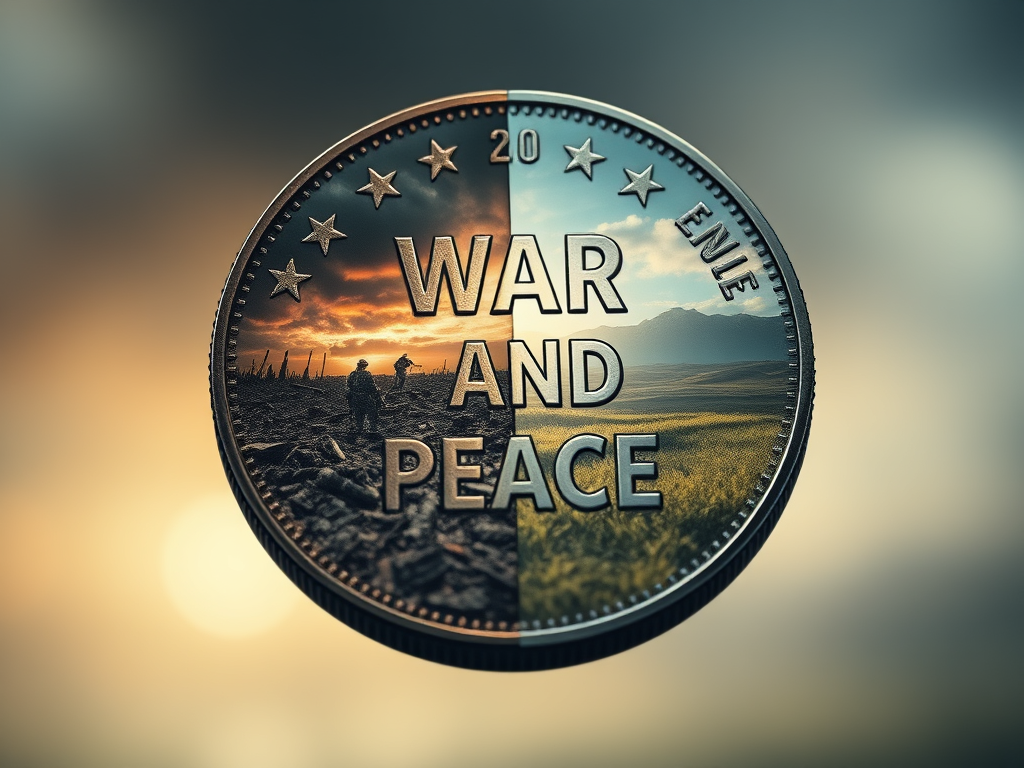
It is called War AND Peace, not War OR Peace.
Justice may sound noble, yet it survives only when it is actively protected. Moreover, justice in wartime exists solely where it can be enforced. Tolstoy expresses this through narrative, while game theory confirms it through the logic of moves and countermoves.
War and Peace as a System
War and peace are not opposites; rather, they are two sides of the same historical coin. Once this becomes clear, the present moment shifts in meaning. Russia’s war against Ukraine is not merely a sequence of frontlines, negotiations, weapons deliveries, or summit declarations. Instead, it is a system shaped by decisions, habits, illusions, and the human tendency to ignore emerging dangers until they directly affect one’s own life.
Today, the word “war” has become almost casual. Terms like war-ready or war-capable carry far more weight than their surface suggests. Media often focus on the moment of the explosion, the day something “begins,” the instant when commentators declare: now it is war. However, that moment is not the beginning; it is merely the tipping point. Peace has already transformed into war long before the first detonation. Consequently, the real question becomes: What preceded this moment, and why did it lead here?
Nothing collapses suddenly; instead, it collapses quietly. Threats slowly turn into “rhetoric,” violations into “grey zones,” and dependencies into “constraints.” As a result, peace erodes long before anyone notices.
Peace is not discovered; it is guarded.
Moral Pressure and Historical Weight
Once war begins, it reveals a brutally realistic core. Justice often becomes a function of power, even though norms such as law, guilt, and responsibility remain conceptually important. Nevertheless, without enforcement, these norms rarely prevail. This tension between moral aspiration and practical limitation has accompanied political thought for centuries.
Philosophers like Kant and Rousseau insisted on duty, responsibility, and moral clarity. Yet war, suffering, and destruction continue to return. Therefore, the question persists: Where does morality go once war begins, and how does justice survive when confronted with force?
Morality without enforcement remains theory.
The central issue is not only what is moral or just, but who possesses the power to define morality. Wars reopen old accounts. Conflicts expose wounds that were hidden beneath layers of convenience and denial. Consequently, systems must confront what they ignored, postponed, or reframed. War does not create justice; instead, it reveals the injustice tolerated for too long.
War is never comfortable. It is the result of responsibility deferred. People and states do not choose war because it is simple; they choose it because they avoided the difficult decisions that could have prevented it. Therefore, war is not a solution but a consequence — the late price of neglected prevention.
War is not an escape; it is the cost.
The Dynamics of Escalation
History rarely shifts through a single dramatic moment. Instead, it moves through chains of small decisions that gradually align in the same direction. Every action produces a reaction; every move generates a countermove. Consequently, some steps should never be taken, because the reaction of the other side can already be anticipated.
The idea of a quick victory is a dangerous illusion. It rests on reflex, prestige, and the belief that escalation can be controlled. One person draws a weapon, another follows. One strike leads to another. Although matching aggression may feel justified, it is rarely wise.
Without prevention, attention, and foresight, escalation becomes inevitable. Every decision must be considered with care. Otherwise, the one outcome nobody desires emerges: escalation, and eventually war.
Peace requires continuous work. War is the result of neglect.
Power, Enforcement, and Historical Reality
History is shaped not by single decisions but by sequences of small steps. Eventually, the first shot is fired, and from that moment onward, the grammar of morality changes. People may continue to argue about justice, yet the peace signed at the end usually reflects the military reality. Justice does not disappear; instead, it becomes a question of enforceability.
If escalation is not prevented, justice will be debated under conditions set by others.
Plans, principles, and moral arguments matter. Nevertheless, power often determines the outcome. This insight is not an excuse; it is a warning against political romanticism. In war, different rules apply. Law may clearly identify who crossed a boundary, but a just peace does not arise from correct diagnosis alone.
A just peace requires strength, not only words.
To achieve justice, enforcement is necessary. Protection, deterrence, and guarantees matter. Morality remains powerless if it is not defended. Eventually, the winner defines the narrative. All moves are made, all shots fired, and the game ends. The loser loses not only the field but also the authority to define justice.
Reality shapes justice. What remains of morality when justice is defined after the war?
Further Reading:
[1] Tolstoy – War and Peace (English, legal full version).
https://standardebooks.org/ebooks/leo-tolstoy/war-and-peace/louise-and-aylmer-maude
[2] Stanford Encyclopedia of Philosophy – Tolstoy’s Aesthetics.
https://plato.stanford.edu/entries/tolstoy-aesthetics/
[3] Stanford Encyclopedia of Philosophy – Philosophy of War.
https://plato.stanford.edu/entries/war/