
The New Unrest in the Modern World: Where the Average Person Stands
Today, as we enter what many describe as War and Peace in the Modern World, we are no longer facing a single conflict but two major wars in which two world powers are the central actors. When I wrote my first column on Tolstoy’s War and Peace in the context of the Russia–Ukraine war, the real world began to move faster than anyone could interpret it. It felt as if the thoughts themselves had become heavier than the pages. War and peace are not opposites; they are two conditions of the same world, two sides of a coin that never stops turning. At the same time, the powerful make their moves, and the question remains: where does the average person stand in this game, and what does this coin mean for him?
A World Losing Its Stability
The war in Ukraine, the conflict in the Middle East, and the tensions in the Indo‑Pacific are not isolated events. They are symptoms of a world order that no longer exists in the form we once knew. History rarely tips in a single moment. Instead, it tips when countless small steps can no longer be reversed, when habits, illusions, and political routines overlap for so long that reality finally catches up.
Ray Dalio argues that all empires follow the same patterns of rise and decline. We are living in that in‑between space. The United States looks late‑cycle, China is emerging as a new actor, Russia is in decline, India is rising, Europe remains fragmented, and Iran is pursuing ambitious goals. It is the kind of transitional phase Dalio describes as chaotic, dangerous, and inevitable. The Iran–Israel conflict is therefore not merely a regional war but a symptom of a global power shift. Just as 1918 was not the end of the First World War but the beginning of three years of chaos in Eastern Europe.
Prit Buttar describes that period as a web of nationalism, revenge, power vacuums, and countless local wars. Today we are witnessing something similar — only this time in real time. We are watching it unfold, fully aware that we are walking into a world that grows more restless by the day. Many people feel this shift long before they understand it. In this development, the dynamics of War and Peace in the Modern World become painfully visible.
War and Peace in the Modern World
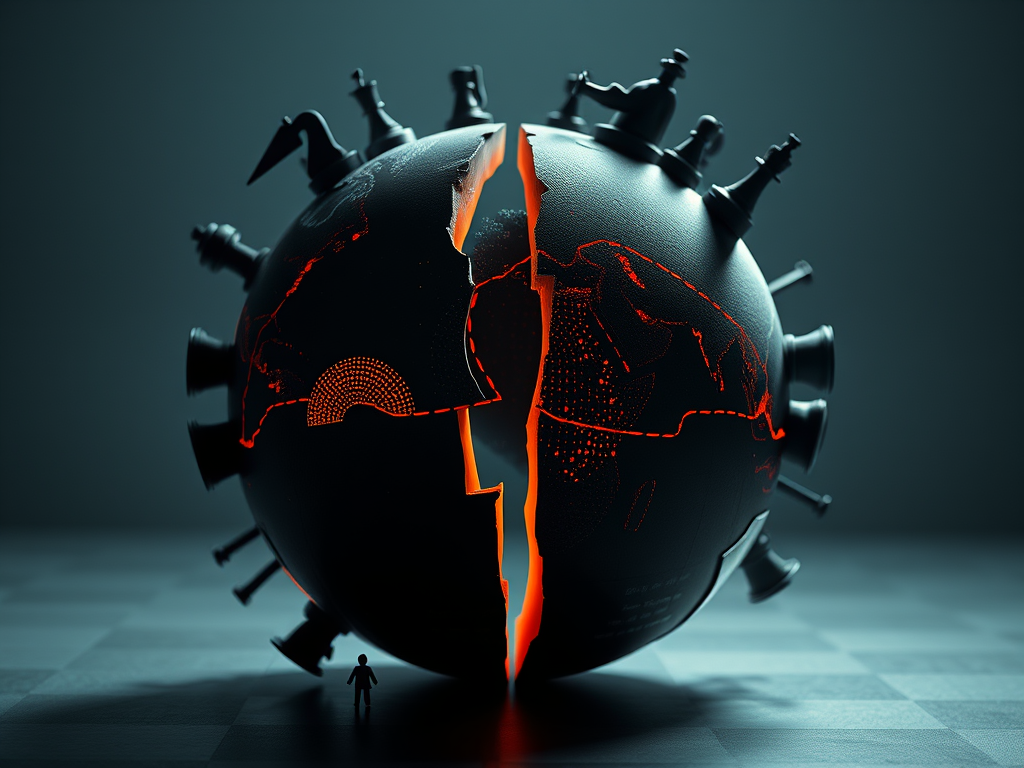
From a game‑theoretical perspective, we are no longer in a system with two players but in a network of many actors whose moves constantly influence one another — a landscape shaped by War and Peace in the Modern World. The present no longer resembles a single chessboard but ten games played simultaneously, each move altering all the others. Iran and Israel, the United States and China, Russia and Ukraine, Turkey and the Kurds, China and Taiwan, Saudi Arabia and Iran, states and militias — everything is connected. A signal to one actor is read by all the others, each interpreting it differently. As a result, this is the material from which escalations emerge.
Tolstoy would say that history is not made by great men but by countless small decisions. Today those decisions are drone strikes, sanctions, proxy operations, cyberattacks, and misunderstandings. There are so many actors that one can hardly list them. For many observers, the landscape feels overwhelming, and it is no surprise that many no longer want to watch or listen to the news at all.
When Order Breaks Down
Buttar shows how, after 1918, armies in Eastern Europe dissolved, militias emerged, borders blurred, and identities were reinvented. Officers woke up in a world where their army existed one day and no longer existed the next. This mechanism is timeless. When order collapses, peace does not emerge — a vacuum does. And a vacuum is the natural enemy of stability. The Israel/US–Iran tensions and the Russia–Ukraine war are deep fractures in the global foundation. It is not one great war but many small ones that ignite each other.
The Return of Fear
Philosophically, we are returning to very old questions. Kant believed in a world where peace arises through law, treaties, reason, and shared rules — the idea that people and states adhere to what they sign, and that order emerges from insight.
However, Hobbes describes a world in which security always comes first. When people or states feel threatened, they do not act out of morality but out of fear. They reach for what protects them, not for what is right.
That is exactly what we see today. States do not act because they want to but because they believe they must. Deterrence replaces trust. Security replaces values. Power replaces arguments. Morality remains important, but it only works when it is protected.
Dalio describes this condition with sober clarity: order does not arise from wishes but from power relations. When those relations begin to wobble, the world becomes restless, no matter how many treaties exist.
The New Way of Waging War
War is no longer a battlefield one enters or leaves. It is a mesh of drone swarms, cyberattacks, GPS interference, artificial intelligence, militias, propaganda, and information warfare. The battlefields have not disappeared — they have multiplied. The front no longer runs only between armies but also between networks, data streams, power lines, satellites, and infrastructures that sustain daily life. This is a kind of war one does not always see, but its consequences are felt long before the first shot is fired.
The Crumbling Illusion of Prosperity
As all this unfolds, people in wealthy countries feel a new and unfamiliar fear. Most have grown accustomed to a world that was historically unnaturally stable. Post‑1945 Europe, the Gulf states after the oil boom, North America during the tech boom, East Asia after its economic miracle — these were decades in which people believed peace was normal, prosperity guaranteed, security self‑evident, and conflicts far away. Now that illusion is cracking. And it feels like the destruction of a dream — or a dream world.
Because of this, prosperity reveals its fragility. It is politically enforced, militarily secured, and geographically advantaged. When these pillars shake, everything shakes. The average citizen senses this without being able to explain it. He sees rising prices, fragile supply chains, geopolitical tensions, burning tankers, drones over refineries. He sees a world becoming restless and feels that his life depends on it, even though he controls none of it.
Geography Strikes Back
Geography plays a larger role than many want to admit. Caesar knew this and wrote extensively about how seasons, nature, and terrain determine whether a campaign succeeds or fails. Buttar shows the same when he describes how rivers, swamps, and plains shaped the Eastern Front. The present confirms it. Ukraine remains unconquerable. Iran is a plateau, a mountain range, a labyrinth. The Strait of Hormuz is a bottleneck that can strangle the global economy. Those who understand geography understand war. Those who ignore it can lose despite military superiority — or win only at immense cost.
The Quiet Beginning of Decline
Decline does not begin with the fall of a capital or the collapse of a currency. It begins when a society no longer invests its energy in the future but in the survival of the present. That is exactly what we see today. High debt, stagnating innovation, geopolitical overload. The forces that once created prosperity are now needed to manage conflict. When states feel threatened, their time horizon shrinks. They no longer think in decades but in months. Not in innovation but in stability. Not in prosperity but in preservation. As a result, the more resources flow into conflict, the less remains for the future. The less future there is, the more conflict emerges — a closed, dangerous loop that defines much of what we now experience as War and Peace in the Modern World.
Understanding War and Peace in the Modern World
While Russia and the United States are openly entangled in conflicts and Europe reacts nervously to every escalation, two emerging world powers appear remarkably calm. China and India observe the situation with a composure that many in the West find unsettling. But this calm is not indifference. It is a mixture of strategic patience and historical experience.
China thinks in long timeframes — not election cycles but centuries. India thinks in civilizational arcs, not alliance structures. Both have learned that great powers do not rise through impulsive decisions but by exploiting the mistakes of others. They know that an exhausted system creates space for them, and they know that a war one does not have to fight is often the most valuable victory.
One could call it the calm before the storm. Nevertheless, one could also call it the calm of a civilization that understands that wars rarely have winners. While the West escalates in real time, India and China wait. Not out of weakness but out of calculation. Not out of fear but out of experience. Their silence is not retreat — it is a form of power.
My Personal Conclusion
When you read these old texts closely, you get the feeling that everything repeats itself and that the future awaiting us has already been described. I do not want us to repeat every mistake. But as an average person, I lack the solution — a way out, a future that is good for everyone, a world in which War and Peace in the Modern World remains the side of the coin that guides us.
In the end, the hope remains that the coin will one day fall back to the right side — Peace.