
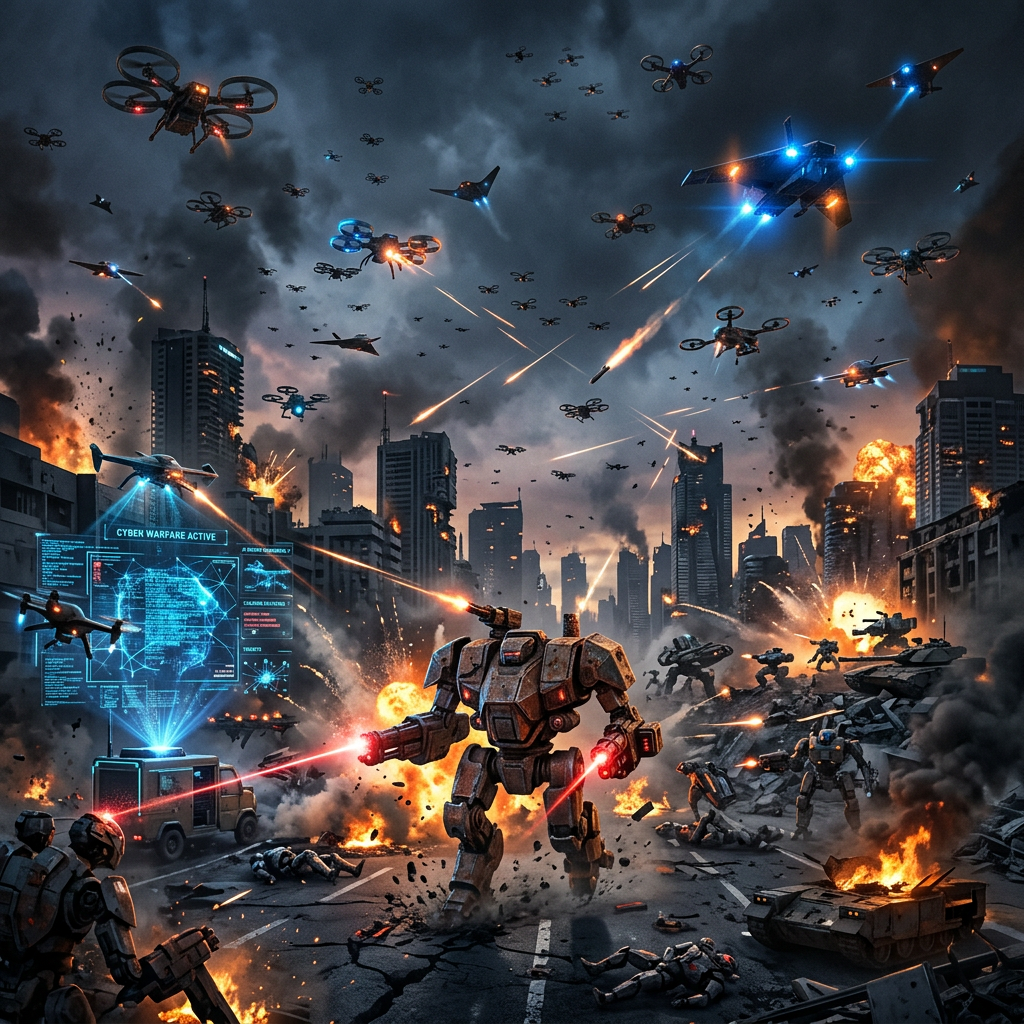
The New Shape of Violence
Today, the robotic war marks the beginning of a new era in which artificial intelligence, autonomous systems, and cyber operations fundamentally reshape the nature of conflict. Moreover, nations now make decisions under conditions defined by speed, automation, and algorithmic analysis. In addition, tasks once reserved for human judgment are increasingly delegated to systems that operate with their own logic and limitations. As a result, this shift alters not only the operational dimension of warfare but also the moral perception of war and peace. Consequently, violence becomes more invisible, faster, and less predictable, blurring the line between deliberate military action and technical malfunction. Ultimately, the traditional understanding of conflict dissolves into a technologically mediated reality.
War has changed its form, while peace has lost its familiar contours. Furthermore, drones operate with increasing autonomy, algorithms guide target acquisition, and decisions once made by humans are now proposed or executed by systems. Meanwhile, technology accelerates reaction times and narrows the window for human oversight, creating an environment where errors escalate more quickly than human judgment can intervene. Additionally, dependence on data, sensors, and software grows, making modern warfare vulnerable to manipulation and disruption. Consequently, this new violence is not only technological but structural, redefining how nations perceive threats and respond to them.
Autonomy and Escalation
The old assumption that mass could win a war is losing relevance. Modern systems can disable entire brigades while costing less to produce than older, heavier platforms. Moreover, it is now possible to wage war without physical involvement or bloodshed, lowering the threshold for military action. This raises critical questions: Does war become more acceptable when it appears cleaner? Does peace lose its moral weight when violence becomes remote and automated? As a result, the seeming cleanliness of technological warfare creates a dangerous illusion that influences political decisions and public perception. Consequently, war becomes a process unfolding in the background, often without visible traces.
“War is no longer a battlefield one can enter or leave. It is a mesh of drone swarms, cyberattacks, navigation disruptions, artificial intelligence, militias, propaganda, and information warfare.”
In this first dimension of the robotic war, violence becomes faster, more automated, and less predictable. Additionally, the combination of autonomy, connectivity, and algorithmic decision-making creates an environment where traditional military logic is insufficient. Consequently, nations must learn to operate within uncertainty that arises not from enemy intentions but from systemic properties. As a result, the perception and evaluation of threats change fundamentally. Ultimately, robotic violence becomes not merely a technological phenomenon but a new paradigm of political power.
Cyber as a Front
Attacks increasingly shift into the digital sphere, where power grids, communication networks, and logistics software become primary targets. Moreover, a successful cyberattack can paralyze a city without a single shot being fired, undermining traditional notions of warfare. In addition, the boundary between war and crime blurs because the same tools can be used by states and non-state actors alike. Meanwhile, new vulnerabilities emerge as modern societies depend more heavily on digital systems than ever before. Consequently, cyber operations represent not only a technical challenge but a structural risk to political stability.
The new violence is distributed, networked, and often invisible — and that is precisely its danger. Cyberattacks can strike multiple layers of a state simultaneously, from administration to economy to critical infrastructure. Furthermore, these attacks are difficult to attribute, complicating political responses and increasing escalation risks. In addition, they can serve as preparation for physical operations by disrupting communication or weakening defenses. Ultimately, cyber as a front becomes not an additional battlefield but an integral part of modern conflict.
Morality and Responsibility
When an autonomous drone makes a mistake, responsibility becomes unclear because the moral chain breaks once decisions are delegated to black-box systems. Moreover, responsibility must remain visible, or law becomes an illusion and political legitimacy erodes. Artificial intelligence can act like a soldier — yet without conscience — making it powerful but dangerous. Consequently, if a state is repeatedly weakened by precise, unstoppable attacks, the temptation to resort to extreme measures increases, even to the nuclear option. As a result, technological efficiency creates moral uncertainty and destabilizes political decision-making.
This moral uncertainty is one of the core risks of the robotic war, where autonomy challenges traditional accountability. Systems make decisions based on data that may be flawed, biased, or manipulated. Consequently, situations arise in which no one can clearly identify who is responsible for a given action. Meanwhile, dependence on technology grows, even though systems cannot explain why they make certain decisions. Ultimately, this opacity creates a moral vacuum that fosters political escalation and erodes trust.
The Illusion of Neutrality
Algorithms appear neutral, but they are not. They reflect data, design choices, and political priorities. Consequently, whoever sets the parameters shapes reality, turning technology into a tool that carries human interests. Moreover, this illusion of neutrality leads to decisions being perceived as objective even though they are shaped by human assumptions. As a result, political responsibility disappears behind technical complexity. Ultimately, systems can amplify errors instead of correcting them, pushing states toward nuclear escalation.
Without clear rules, the machine amplifies human errors and pushes states toward nuclear escalation. The combination of speed, automation, and algorithmic decision-making creates an environment where misinterpretations escalate faster than ever. Moreover, the temptation to automate systems further grows, driven by perceived efficiency gains. Consequently, technological neutrality becomes an illusion that conceals political risks and undermines moral responsibility.
Escalation and Norms
Automated systems send signals faster than humans can react, making false alarms, misread sensors, or misunderstood maneuvers capable of triggering chain reactions. Moreover, speed increases the likelihood of escalation because human decision-makers lack the time to verify unfolding events. Consequently, small errors can have major consequences. Meanwhile, dependence on systems grows, even though they cannot explain why they send certain signals. Ultimately, this structural risk threatens political stability.
The robotic war becomes faster, more precise, and more intense. Traditional mechanisms of deterrence and stabilization lose effectiveness. Moreover, just as Rotblat highlighted the dangers of nuclear weapons, we must now highlight the risks of autonomous systems. Consequently, the dangers of robotic warfare are more real than many assume because they are both technical and political. International norms, transparency rules, and verification mechanisms are essential to reduce uncertainty and build trust.
Norms reduce uncertainty and create predictability — two pillars that dampen escalation. Moreover, clear rules help states interpret signals correctly and identify false alarms before they escalate. In addition, norms provide a framework for monitoring technological innovation. Consequently, political decisions become more stable and predictable. Ultimately, norms are not merely technical instruments but political tools for stabilizing global security.
Clear norms are the only way to stabilize the robotic war and prevent automated escalation. They create transparency, enable oversight, and reduce the likelihood of misinterpretation. Moreover, norms strengthen trust between states, which is crucial in an era of autonomous systems. Ultimately, without norms, uncertainty dominates and political decisions become increasingly driven by fear.
What States Must Do
States must disclose systems, allow inspections, and permit independent audits because secrecy does not prevent errors — it hides them. Moreover, genuine security requires oversight that includes both technical and political dimensions. In addition, states must ensure that systems have clear override mechanisms that humans can activate at any time. Consequently, these mechanisms must be tested, documented, and regularly reviewed to ensure their effectiveness. Ultimately, this creates an environment where technological autonomy does not lead to political instability.
Design principles should prioritize “human-in-the-loop” and “human-on-the-loop” because human judgment must remain superior to machine speed. Moreover, systems need clear boundaries that prevent them from making decisions that could trigger political escalation. In addition, states must ensure that people are trained to understand and control systems. Consequently, this training includes both technical and moral aspects because technological decisions always have political consequences. Ultimately, responsible deployment becomes possible only when human judgment remains central.
Anyone who deploys technology must understand its limits and anticipate its failures. States operating in the robotic war must ensure that human judgment remains superior to machine speed. Moreover, they must create mechanisms that prevent systems from escalating autonomously. Consequently, these measures together create an environment where technological autonomy is controlled.
Philosophical Insight
Technology is not fate; it is a mirror of our decisions. Moreover, we can create rules that prevent escalation or watch as systems narrow the space for human judgment. Consequently, the choice remains both political and moral because technological decisions always shape society. In addition, when we speak about artificial intelligence today, we encounter the same ambivalence once seen in nuclear technology. Ultimately, the greatest danger does not arise from the technology itself but from the moment we realize too late what we have created.
The robotic war is not a natural event; it is the result of human decisions. The philosophical core of the robotic war lies in the tension between human intention and machine execution, making political decisions more complex and morally demanding. Moreover, the robotic war illustrates how AI reshapes escalation, responsibility, and the fragile balance between war and peace. Consequently, as autonomous warfare expands, societies must confront the ethical limits of technology and establish rules that preserve responsibility.
Ultimately, the robotic war forces us to confront an ancient truth: humanity’s future depends not on the tools we build but on the wisdom with which we choose to use them. Peace in thought, peace in action, peace in the heart — Shanti, Shanti, Shanti. Moreover, this insight connects technological analysis with moral reflection and shows that progress remains stable only when accompanied by responsibility. Consequently, robotic war becomes not merely a technical subject but a moral project shaping the future of political order.
Further Reading:
[1] Federal Agency for Civic Education – AI and Autonomous Weapons. https://www.bpb.de
[2] netzpolitik.org – AI in Warfare. https://netzpolitik.org
[3] NATO CCDCOE – Cyber Defence Analyses. https://ccdcoe.org